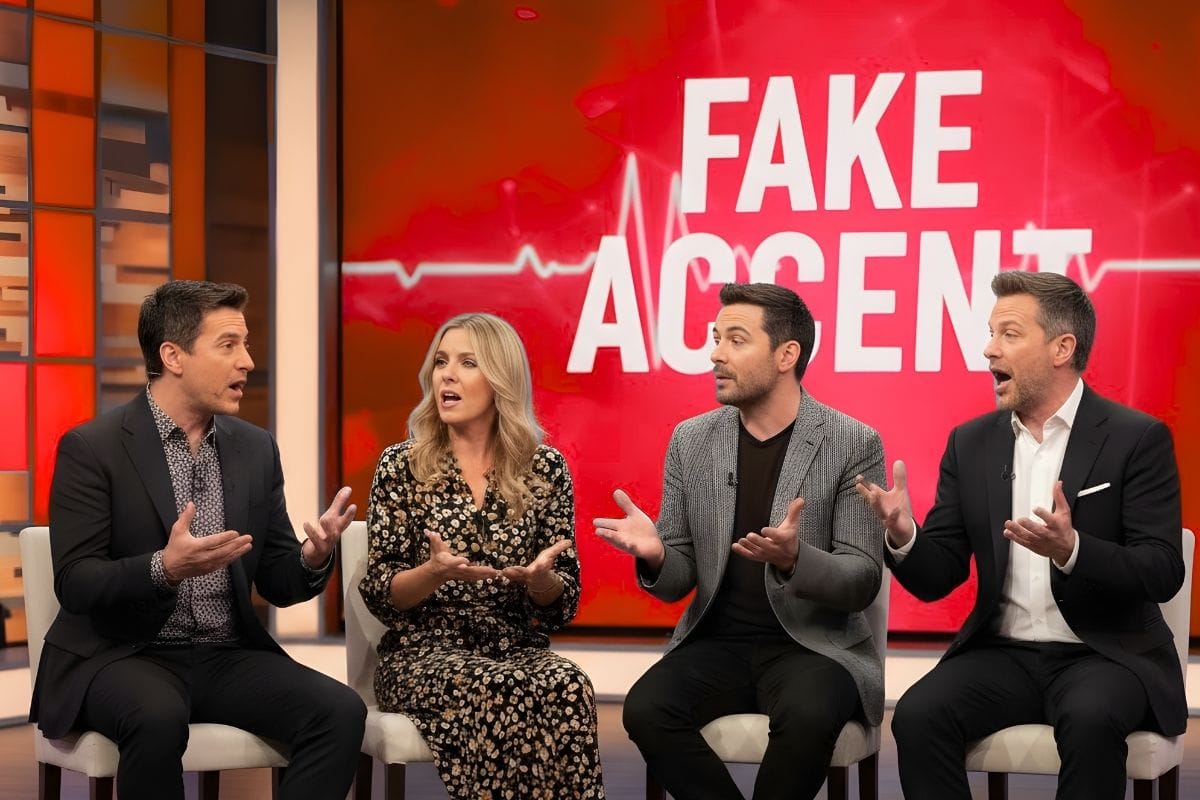
Picture this: It’s a Sunday morning in London, the kettle’s just boiled, and a clip starts autoplaying on your phone. A famous face is talking. Same smile, same hair, same laugh. But the voice? It’s… off. A vowel lands where it didn’t used to. A “t” gets softened into a Mid-Atlantic blur. A rhythm appears that feels imported from a West Hollywood juice bar.
Suddenly, you’re leaning closer, trying to hear the “honesty” beneath the syllables. In the UK, we are uniquely obsessed with this. From Joss Stone’s 2007 “Americanisation” to the collective confusion over Harry Styles’ “Australian-American” twang while promoting his new single ‘Aperture’ yesterday, we treat accents like a moral compass.
But as of January 2026, the debate has evolved. It’s no longer just about “fake” vs. “real”. It’s about “Vocal Settling”, the high-tech feedback loops of modern fame, where the performance voice eventually becomes the only voice left.
So, do any celebrities fake their accents? Sometimes. In this guide, we’ll look at why we naturally copy the way others speak, the weird reason stars like Harry Styles can’t shake their new voices, and if you can actually lose your “real” accent forever.
Why We All Turn Into Social Chameleons
Look, we’ve all done it. You spend forty-eight hours in Liverpool, and suddenly you’re ending your sentences with a Scouse “soften”. Or you binge three seasons of a US drama and start asking people for “gas” instead of petrol. It’s embarrassing, sure, but you aren’t a fraud. You’re just… well, human.
There’s a fancy word for this “mirroring”, but honestly? It’s just your brain trying to be a good guest. Subconsciously, we’re all wired to think, “If I sound like you, we’re on the same team.” It’s a survival thing. We want to be liked, and the easiest way to do that is to match the energy (and the vowels) of whoever is standing in front of us.
Also Read – Celebrity Trivia Questions You Won’t Find on Wikipedia
It’s a Reflex, Not a Script
Your voice isn’t a fixed thing set in stone; it’s more like a mirror.
When a celebrity sits down for their tenth interview of the day with someone from New York or Sydney, their brain starts taking shortcuts. Millie Bobby Brown caught a lot of flak for this (the internet dubbed it “Accent-Gate”), but her explanation actually makes sense. When she’s with her American husband’s lot, the US twang comes out. The second she’s back in the UK with her family? The Dorset roots snap right back into place.
It’s the exact same story with Harry Styles. In that January 2026 Aperture interview that’s currently doing the rounds, he sounds like a bit of a global soup. He’s not being “Billy Big Bollocks” or trying to act posh; his brain has just spent so much time on private jets and in international studios that it doesn’t know where “home” is anymore. He’s mirroring a world that has no fixed postcode.
The “Cringe” Factor
Here’s the kicker: we actually mirror people more when we like them.
If a star really respects the person interviewing them, they’ll “slide” into that person’s accent without even noticing. To us watching on TikTok, it looks cringe. It looks fake. But in the room? It’s actually a subconscious compliment. It’s their brain saying, “I’m with you.”
When the Job Gets Stuck in Your Throat: Vocal Settling
There’s a massive difference between “copying” someone to be polite and literally forgetting how your voice works. This is the bit that really winds people up on social media, but it’s actually the most fascinating (and slightly terrifying) part of being an actor.
Think about Austin Butler. The man spent years, not weeks, living, breathing, and singing like Elvis Presley. He didn’t just “do” the voice for eight hours and then go home and talk like a California surfer. He lived in that register.
When the cameras finally stopped rolling, his vocal cords didn’t just snap back like a rubber band. His body had physically habituated to that deep, Southern rumble.
The “Glinda” Glitch
We’re seeing it again with Ariana Grande. After filming Wicked, her speaking voice shifted into this higher, lighter, more “proper” Glinda-style lilt. The internet, of course, went for the jugular, calling it a fake persona.
But if you’ve ever spent months training your voice for a specific sound, whether it’s for a film or an opera, you’ll know that your muscles develop a mind of their own. It’s like a “vocal glitch”. You want to say a word one way, but your throat is already halfway through the “trained” version before you can stop it.
Why It’s Not a “Con”
It’s not a conspiracy. It’s basically Muscle Memory. If you spend 14 hours a day on a film set being told “Great job!” every time you sound like a certain character, your brain starts to reward that sound. Eventually, that sound becomes the “safe” default.
So, when Gillian Anderson or Austin Butler switch voices, it’s often because they are “vocal settling”. They are trying to find the middle ground between who they were and who they’ve been playing. It’s messy, it’s awkward, and it’s usually anything but fake.
Also Read – Biggest UK Celebrity Headlines
The “Vocal Parasite”: How Tech Actually Steals Your Voice

Now, here’s the real kicker that the tabloids completely miss. While everyone’s on Twitter screaming “fraud”, we’re ignoring how much technology has messed with the celebrity brain. In 2026, being a star involves living inside a permanent high-def echo chamber.
Think about it. These people stick In-Ear Monitors (IEMs) in their ears for sixteen straight hours. Whether they’re travelling around the world or milling around a huge movie set, they’re not experiencing the world like you and I are. They are hearing a bright, cleaned-up, studio-polished version of their own voice funnelled straight into their ear canals. All. Day. Long.
This creates what I call the “Vocal Parasite.”
When you hear your “performance voice” through a three-thousand-pound piece of tech more often than you hear your natural voice through the air, your brain gets confused. It starts to prioritise the shiny version.
For someone like Harry Styles, that “global” drawl isn’t a choice anymore, but it’s a feedback loop. That Cheshire playground voice? It’s gone. It’s been buried under a decade of hearing himself through a monitor that’s tuned for a stadium in LA, not a pub in Holmes Chapel.
The performance voice literally feeds on the original. It’s a parasite that eventually takes over the host.
Just watch the clips from this week’s January 2026 press tours. You’ll see these stars looking almost startled by what’s coming out of their own mouths. They aren’t trying to pull a fast one on us. They’ve just lost their anchor.
Between the TikTok loops, the studio playbacks, and the constant digital mirroring, their internal “map” is totally trashed. They aren’t faking a new identity; they’ve just been digitalised into oblivion.
Let’s Be Real: When the Accent is a Total Con
Right, let’s stop being polite for a minute. We’ve talked about “vocal parasites” and brains being mirrors, but sometimes? Sometimes a fake accent is just… a fake accent. It’s a career move. A costume. A bit of a swindle.
The internet doesn’t just get angry for fun (well, mostly). It gets angry because we hate being lied to. Take Hilaria Baldwin. That wasn’t some “oops, I spent a week in Madrid” slip-up. It felt like a full-blown identity project built on shaky ground. When you use an accent to pretend you’ve got a “struggle” or a “spice” that you didn’t actually grow up with, people are going to call you out. And honestly? Fair play to them.
The “Street Cred” Pivot
You see it in music all the time. A kid grows up in a posh Surrey mansion, goes to a private stage school, then gets a record deal and suddenly starts talking like they’re from the roughest estate in East London.
It’s the Chet Hanks vibe. It’s an attempt to buy “edge.”
In these cases, the accent isn’t a medical glitch or a psychological reflex. It’s a brand. It’s meant to make the artist seem more “authentic” or “soulful” than their actual life was. The irony is that by trying to sound more “real”, they end up looking like the biggest fakes in the room.
The Celebrity Accent Cheat Sheet (2026 Edition)
| Celebrity | The Accent Shift | The Most Likely Cause | Verdict |
| Harry Styles | Mid-Atlantic / “Global Soup” | The Vocal Parasite: Years of hearing his own voice through IEMs. | Real Reflex |
| Austin Butler | Deep Elvis Rumble | Muscle Memory: His vocal folds physically “set” during filming. | Body Glitch |
| Millie Bobby Brown | British — American | Social Mirroring: Subconsciously copying whoever she’s with. | Social Reflex |
| Ariana Grande | High-pitched “Glinda” lilt | The Glinda Glitch: Professional habituation after years of training. | Work Habit |
| Hilaria Baldwin | Spanish Inflection | Identity Branding: A deliberate choice to adopt a specific persona. | Brand Choice |
How to Spot the Fakes (The 2026 Way)
If you want to know if a star is pulling a fast one, don’t look at their vowels. Look at their consistency.
- The Mirrorers (The “Real” Ones): People like Harry Styles or Millie Bobby Brown are a mess. They sound different in every interview. Their voice is a total soup. That’s actually a sign of a real human brain trying to adapt.
- The Con-Artists: They are too perfect. They’ve practised the slang. They never slip up… until they get properly annoyed or surprised.
The “Home Voice” is a stubborn thing. It’s always there, hiding in the basement. Wait for a celebrity to get truly riled up on a podcast, and that’s when the “private school” or the “small town” voice finally makes an appearance.
Also Read – UK High Street is Obsessed with Celebrity Endorsements
FAQs: Your Burning Questions Answered
Can a celebrity actually lose their original accent for good?
The short answer? Yes. But it’s not like they woke up and forgot where they were born. Linguists call it “First Language Attrition”. If you move to LA at eighteen and spend twenty years surrounded by Americans, your brain literally rewrites your “speech map”. By the time you’re forty, your original accent isn’t a choice anymore but a memory.
Why do British singers sound so American when they sing?
Not because they’re “selling out”. It’s actually physics. Most pop and rock songs are written around American vowel shapes. If you attempt to sing a huge pop chorus in either Brummie or Scouse, you will find that it feels clunky. Singers ‘neutralise’ their voice so that it fits better to the music.
How can I tell if someone is properly faking it?
Wait for them to get tired, or to be angry, or emotional. A “costume” accent is work that takes labour to perform, even in the mind. The mask typically falls when a celebrity engages in an argument or dissolves into laughter on a podcast. Listen out for the “T” sounds and the vowels, that’s where the hometown roots are lurking.
The Final Verdict: Is Anyone Real Anymore?
So, back to the big question: Do celebrities fake their accents?
Sure, some do. There will always be the “rebranders” trying to sound more street, more posh, or more exotic to sell a record. But in 2026, the truth is usually much messier. Between the “Vocal Parasites” of modern tech and the “Glinda Glitch” of method acting, most stars are just as confused about their voices as we are.
We want our icons to be “authentic,” but we forget that their lives are anything but. When your home is a private jet and your “family” is a film crew from five different continents, your voice becomes a souvenir of everywhere you’ve been.
Next time you hear Harry Styles or Millie Bobby Brown sounding a bit “off,” don’t reach for the pitchfork. They aren’t necessarily lying to you. They might just be what happens when a human voice has no fixed postcode left to call home.
Anyway, think about your own “phone voice” for a second. We’re all a little bit fake, aren’t we?
Sources & References
- The Independent (Jan 23, 2026): “Harry Styles fans notice something different about star as he makes musical comeback.” Link to Article
- BBC Radio One (Jan 23, 2026): Exclusive interview with Harry Styles on the release of his single “Aperture.”
- Communication Accommodation Theory (CAT): Overview of linguistic mirroring and convergence in social psychology. [Source: Giles & Coupland, 1991]
- Digital Spy (Archived): “Austin Butler on the struggle of losing the Elvis accent.” Link to Article
- HuffPost Celebrity: Address of “Accent-Gate” and Millie Bobby Brown’s speech evolution (2024-2025 coverage).
- Linguistic Research: First Language Attrition — The study of how people lose their mother tongue in new environments.