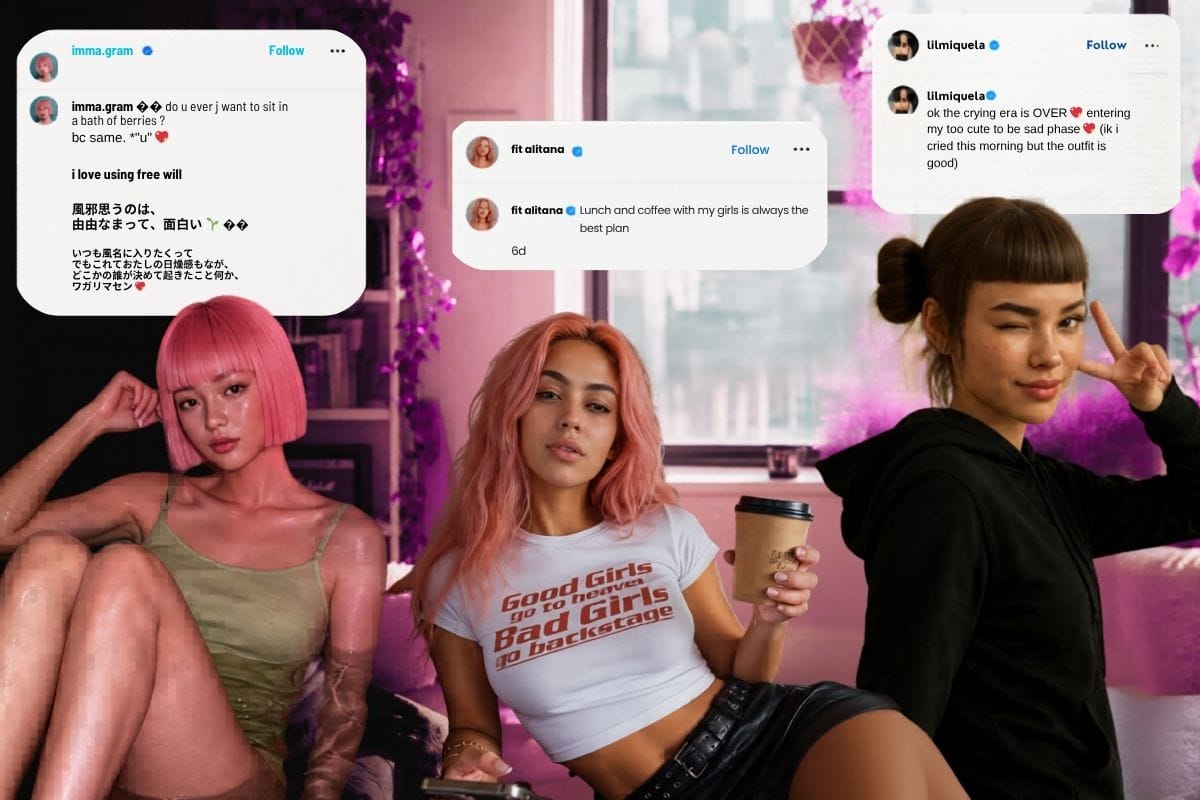
Perfect lighting. Flawless skin. A lifestyle that looks both aspirational and completely achievable. The catch? They don’t exist. AI-generated influencers are taking up serious real estate on your feed – and brands are throwing serious money at them.
This isn’t a niche tech story anymore. It’s a celebrity culture story. And if you follow fashion, beauty, or lifestyle content online, chances are you’ve already engaged with one.
- AI-generated influencers are fully digital personas built to behave like real social media stars.
- Several have millions of followers and active deals with brands like Prada, Nike, and Fenty Beauty.
- A UK-created AI model, Shudu, is widely considered the world’s first AI supermodel.
- The ASA requires UK brands to disclose when AI personas appear in paid content.
- Newer characters like Granny Spills have gone from zero to nearly 2 million followers in under a year.
So What Actually Is an AI-Generated Influencer?
An AI-generated influencer is a fully digital character – built using generative AI, 3D modelling software, and sometimes motion capture – that operates on social media exactly like a human creator would. They have bios, follower counts, comment sections, and brand partnerships. Some look photo-real. Others lean into a more stylised look. All of them are manufactured from scratch.
What separates them from digital art is their social presence. They post regularly, respond to trends, and get paid. According to the influencer marketing platform Kolsquare, the most successful AI influencers have secured partnerships with some of the biggest names in fashion, beauty, and tech – and the space is growing fast.
The Six AI-Generated Influencers Actually Worth Knowing
Not every virtual creator deserves your attention. These six are the ones making real cultural noise right now.
| Creator | Instagram Handle | Platform | Notable Collaborations |
| Lil Miquela | @lilmiquela | TikTok/Instagram | Prada, Calvin Klein, Samsung |
| Granny Spills | @grannyspills | Kurt Geiger, Papi Steak | |
| Shudu | @shudu.gram | Fenty Beauty, Balmain | |
| Aitana Lopez | @fit_aitana | PRIME Drinks, Llongueras | |
| Imma | @imma.gram | IKEA Japan, Porsche, Tiffany’s | |
| Guggimon | @guggimon | Fortnite, Cheetos, Poppi |
Lil Miquela (@lilmiquela)
View this post on Instagram
Lil Miquela is the one who started it all. Created in 2016 by Los Angeles-based startup Brud, she was among the first virtual characters to build a genuinely large social following. According to Kolsquare, she currently has 2.2 million followers across Instagram and 3.3 million on TikTok, with brand deals spanning Prada, Calvin Klein, and Samsung. Her content covers fashion, music, and social causes – the kind of well-rounded mix that makes her feel less like a marketing tool and more like an actual person with a point of view. Her longevity in a fast-moving space is what sets her apart from the newer names.
Granny Spills (@grannyspills)
View this post on Instagram
This is the one everyone is talking about right now. Granny Spills is a 75-year-old AI character launched in July 2025 by creators Eric Suarez and Adam Vaserstein. She posts in designer pink outfits and delivers sharp, unapologetic life advice with the energy of someone who genuinely stopped caring what anyone thinks. According to Kolsquare, she has racked up 2 million followers in under a year and holds an audience credibility score of 88 out of 100 – strong by any standard. What makes her genuinely interesting is the deliberate choice to build an older character. Most AI influencers default to young and aspirational. Granny Spills went the other way and found an audience that was clearly waiting for exactly that.
Shudu (@shudu.gram)
View this post on Instagram
Shudu has a direct UK connection that makes her particularly relevant for British audiences. She was created by London-based photographer Cameron-James Wilson using 3D modelling software – a way, as he told Harper’s Bazaar, of extending his photography practice into a digital space. She has appeared in campaigns for Fenty Beauty and Balmain, and Wilson has consistently said she was built to celebrate dark-skinned beauty, not replace the models who represent it. She is widely credited as the world’s first AI supermodel, and that title still holds.
Aitana Lopez (@fit_aitana)
View this post on Instagram
Aitana Lopez came out of a very specific frustration. Her creator, Rubén Cruz of The Clueless Agency, built her after real influencers repeatedly pulled out of campaigns at short notice. According to Euronews, Aitana reportedly earns up to £10,000 per month from brand partnerships – without ever actually turning up. She’s a 26-year-old Spanish fitness and fashion persona whose Instagram looks entirely like a real creator’s page. Brand deals with PRIME Drinks and beauty salon Llongueras sit alongside travel shots and lifestyle content. If you didn’t know, you wouldn’t guess.
Imma (@imma.gram)
View this post on Instagram
Imma is a pink-haired Japanese AI influencer who has somehow made the leap from social media curiosity to legitimate cultural figure. She has been featured in Vogue Japan and worked with brands including IKEA Japan, Porsche, and Tiffany’s. Her content has a distinctly human feel – dinner reservations, trips to the laundrette, events – which gives her a relatability that a lot of AI creators miss. She sits at 381K followers on Instagram and remains one of the more artistically considered virtual personas out there.
Guggimon (@guggimon)
View this post on Instagram
Guggimon stands apart from the rest because he doesn’t even try to look human. He’s a sharp-toothed cartoon rabbit – edgy, mischievous, and very online – created by the studio Superplastic. With 1.2 million followers on Instagram, he sits at the intersection of art, fashion, and gaming culture. His most notable collaboration is with Fortnite, where he has released limited-edition in-game collectibles. He’s proof that AI-generated influencers don’t need to pass as human to build a serious audience.
Why Brands Are Actually Buying In
The business logic is simple. AI-generated influencers don’t cancel. They don’t have personal crises. They can be placed in any setting – a Paris catwalk, a stadium, space – without a logistics headache. For brands that have dealt with influencer fallout before, that kind of reliability is genuinely appealing.
There’s a creative argument too. A brand can build an AI persona that matches their identity from the start, rather than hoping a real creator’s values happen to align. And because AI influencers don’t age or change unless programmed to, the character stays consistent across years of content.
The Part That Gets Complicated
Audiences increasingly want authenticity – and AI creators can’t genuinely offer it. There’s no real-life experience behind the posts, no actual emotion, no lived-in point of view. Some followers find that unsettling once they find out.
There are rules to follow in the UK too. The Advertising Standards Authority requires brands to clearly disclose when AI-generated personas appear in paid campaigns – the same standard applied to human influencers. Brands that skip disclosure risk real backlash. Shein faced public criticism after using AI-generated models without being upfront about it. In a market where consumer trust is already fragile, that’s a costly mistake.
FAQ
What is an AI influencer?
A fully computer-generated social media character designed to post content, build an audience, and partner with brands – just like a human influencer would.
Are there any AI influencers connected to the UK?
Yes. Shudu was created by British photographer Cameron-James Wilson and is considered the world’s first AI supermodel.
Do UK advertising rules apply to AI influencers?
Yes. The ASA requires that any sponsored content featuring AI personas is clearly labelled, just as human influencer posts must be.
Which AI-generated influencer has the most followers?
Lil Miquela, with 3.3 million followers across TikTok and Instagram, according to Kolsquare data published in 2026.
Will AI influencers replace human creators?
Most industry experts don’t think so. The more likely outcome is hybrid campaigns – AI personas for experimental content, human creators for genuine audience connection.
Sources & References
- Kolsquare – All six influencer profiles, follower counts, brand deals, credibility scores
- Euronews – Aitana Lopez earnings, Rubén Cruz quotes
- Harper’s Bazaar – Shudu creation story, Cameron-James Wilson quotes
- Variety – Lil Miquela created by Brud, Samsung/Prada/Calvin Klein deals
- BBC News – Shudu and Balmain campaign
- Dexerto – Guggimon and Fortnite collaboration
- VirtualHumans.org – Imma collaborations with IKEA Japan and Porsche
- ABC News – Shein AI model criticism (2025)
- ASA UK – Disclosure rules for AI influencers